
Client Growth in the AI Era: Why Client Growth Looks Different Now
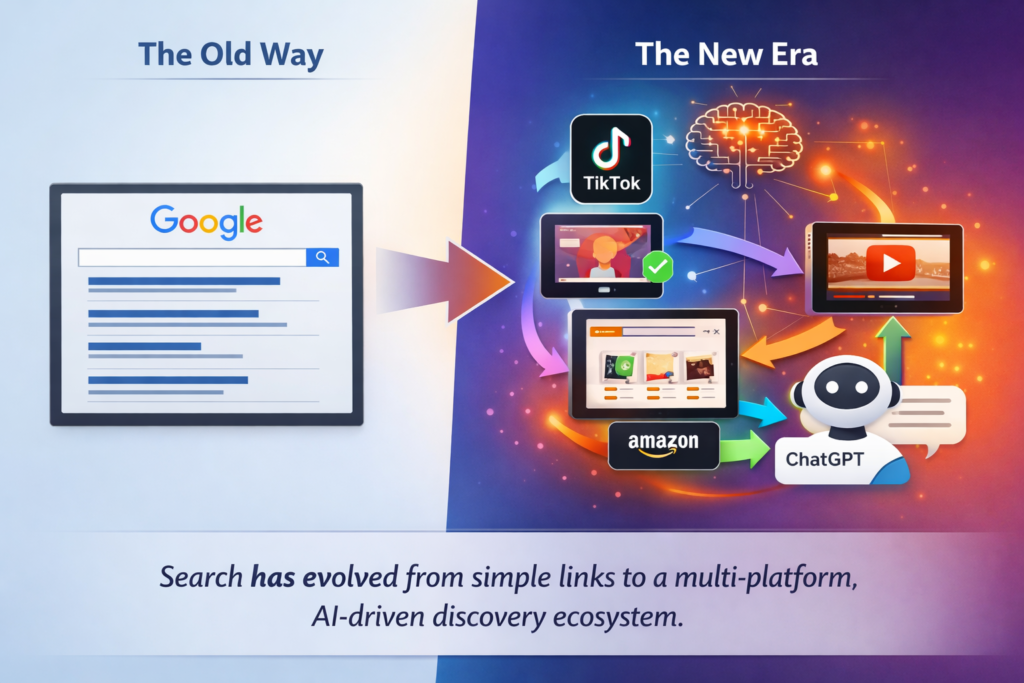
Client growth used to follow a familiar rhythm. A potential customer searched on Google, clicked a handful of links, skimmed a few websites, and made a decision. If you ranked well, you were visible. If you didn’t, you bought ads or waited your turn.
That rhythm is gone.
Today, growth happens in fragments across platforms, feeds, marketplaces, and increasingly, inside AI systems that never show a traditional list of results. Customers don’t just search anymore. They ask. They compare. They sanity-check. They look for reassurance. And they do it everywhere.
This page exists for one reason: to explain how client growth actually works in the AI era, and how modern SEO has evolved from a traffic game into a visibility and trust system.
Not theory. Not hype. A practical blueprint built on real behavior shifts, platform changes, and performance data.
The Search Landscape Didn’t Change Gradually; It Collapsed.
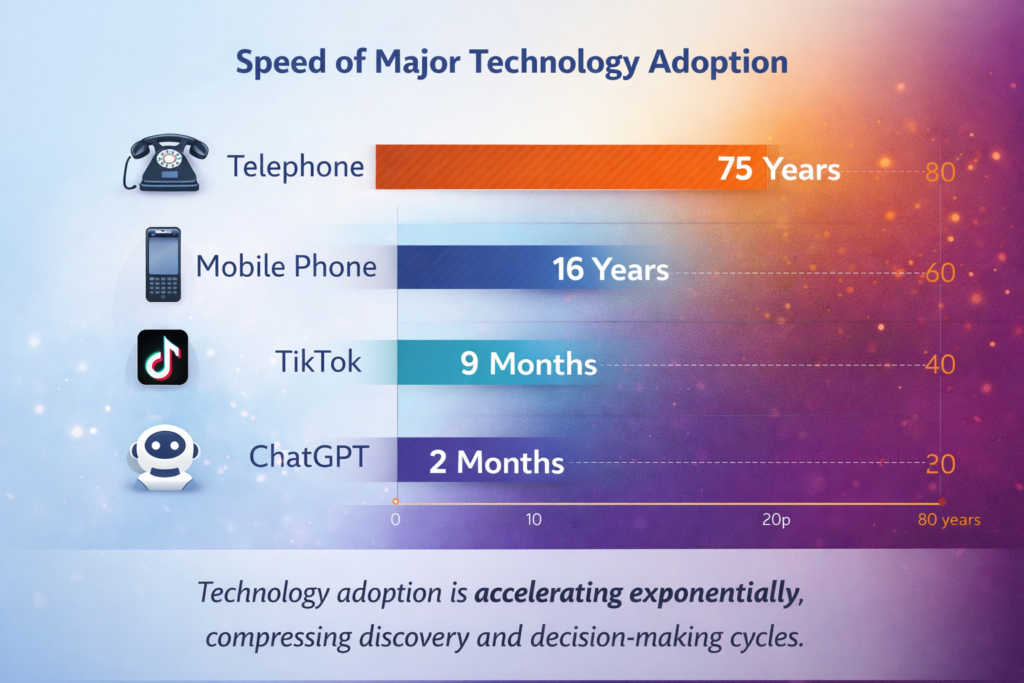
It took the telephone 75 years to reach 100 million users. Mobile phones did it in 16. TikTok needed just nine months. ChatGPT reached the same milestone in roughly two months.
That isn’t just a fun stat. It’s a signal.
According to adoption curve research published by Bain and McKinsey, every major technology wave is compressing faster than the one before it. What once took decades now happens in quarters. That compression doesn’t just change tools—it rewires habits.
Search behavior is one of the clearest casualties of this shift.
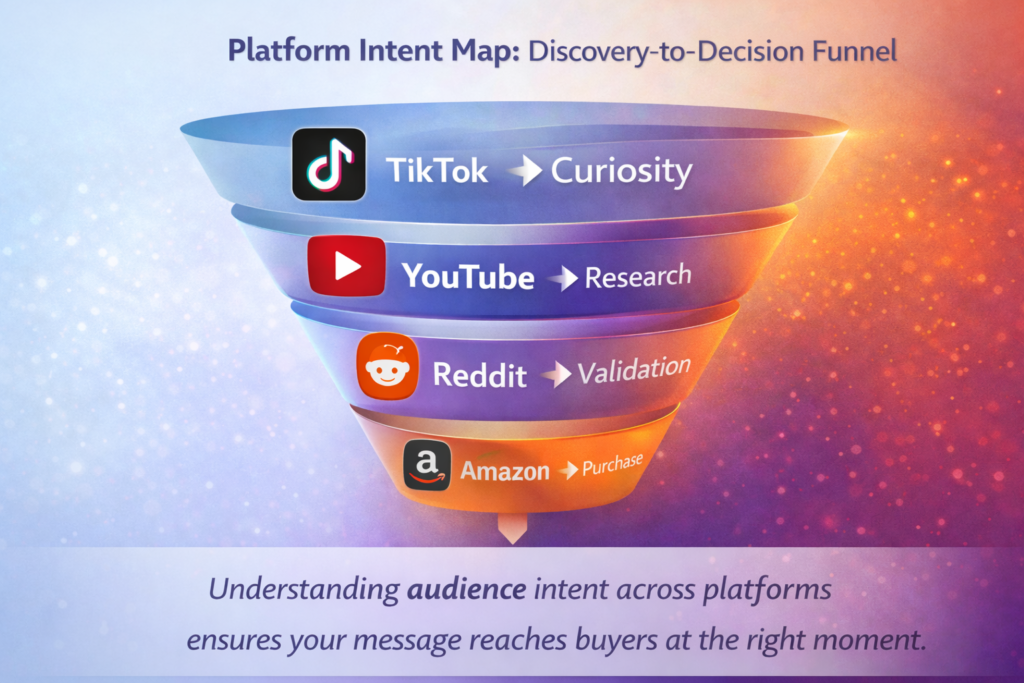
Google shaped how people discovered information for more than a decade, but it no longer owns the entire journey. TikTok sparks curiosity. YouTube builds understanding. Reddit adds friction and honesty. Amazon closes decisions. AI systems tie everything together into a single, confident answer.
Google now acknowledge that a significant portion of searches end without a click. Independent studies estimate that close to 60% of searches either resolve directly on the results page or are absorbed into AI-powered summaries.
And that’s just Google.
Billions of searches now happen entirely off-platform—inside social feeds, marketplaces, and AI interfaces that never send traditional referral traffic at all.
The uncomfortable truth is this: if your growth strategy still assumes that ranking on Google equals visibility, you’re optimizing for a shrinking slice of reality.
Why SEO Is No Longer Just About Google
Modern SEO is not dead. But the Google-only playbook is.
Search is no longer a place. It’s a behavior.
People behave differently depending on where they are. Psychologists call this context-dependent behavior. You act one way in a library and another in a gym. Online, the same principle applies.
On TikTok, people are open to discovery and entertainment. On YouTube, they’re in learning mode. On Amazon, they’re evaluating and deciding. On Reddit, they want unfiltered opinions. Inside AI tools, they’re asking for judgment.
Treating all of these environments the same is like wearing running shoes to a board meeting. You might technically show up, but you won’t belong.
According to platform data and third-party studies, more than 70% of product discovery journeys now involve at least one non-Google platform before a purchase decision is made. That number rises even higher for younger demographics and knowledge-heavy purchases.
SEO today is about being present wherever those decisions are shaped—not just where it feels familiar.
From Rankings to Recommendations: The AI Shift
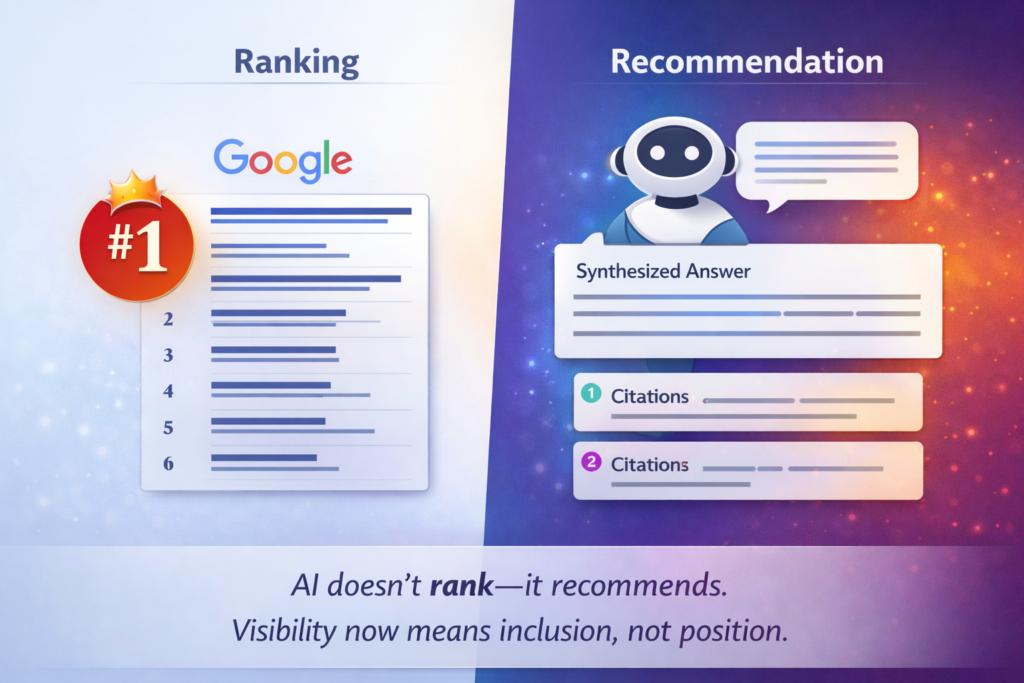
AI systems don’t rank websites the way traditional search engines do. They recommend answers, and that distinction is crucial for businesses aiming to capture high-value traffic. Unlike Google, which still presents lists of links that users scroll through and choose from, AI tools like ChatGPT, Gemini, and Perplexity distill information from across the web and deliver direct recommendations. Users aren’t browsing multiple pages—they’re being guided to what the AI has determined is most relevant, trustworthy, or actionable. Your brand isn’t competing for position in a list; it’s competing for inclusion in the answer itself.
This changes everything about how we approach visibility and content. Traditional SEO focuses on ranking factors like keywords, meta tags, and backlinks, but AI-driven visibility demands clarity, consistency, and structured presentation. At Liam Consulting, I ensure your brand is defined as a single, coherent entity across your website, profiles, and content platforms. Your services, products, and leadership presence all signal authority in a way AI can interpret. Websites are optimized not just for clicks, but for lift—the process by which AI extracts, cites, and trusts your content.
The impact of this shift is profound. Multiple studies from NP Digital and similar agencies show that AI-driven traffic often accounts for less than 1% of total sessions, yet it frequently contributes a disproportionately high share of revenue. In some cases, AI-referred users generate over 10% of total sales, even though the overall visitor numbers seem tiny. Why? Because AI users aren’t passively browsing—they’re deciding. They enter these systems with intent, seeking authoritative guidance, comparison, and recommendations. When your website is structured correctly—fast, scannable, and integrated with clear entity signals—AI lifts your content into the decision-making stream, turning a tiny fraction of traffic into outsized conversions.
Think of it like being invited into the room where decisions are made. A beautifully designed homepage, carefully structured landing pages, and strategically layered content don’t just look professional—they communicate trust and credibility in a way AI recognizes and amplifies. At Liam Consulting, I combine expert web design, content clarity, and AI-optimized SEO to ensure your brand isn’t just discoverable—it’s actively chosen by systems guiding buyers in real time.
When someone asks, “What’s the best option for me?” and your brand is part of the answer, you’re no longer interrupting attention. You’re shaping it.
Step One: Mapping Audience and Platform Intent
Client growth begins with understanding intent, not chasing keywords. Most businesses still pick platforms based on habit, convenience, or trends. They post where it feels familiar, hoping someone notices. But in today’s landscape, that approach leaves huge gaps in visibility and influence. The smarter strategy is to map your audience across platforms and understand what stage of decision-making they’re in at each touchpoint. Only then can your content, design, and messaging align with the signals your customers actually respond to.
Consider the landscape: TikTok thrives on entertainment-led discovery, sparking curiosity and introducing audiences to new solutions before they even realize they have a need. YouTube supports long-form research, helping users compare options, weigh pros and cons, and gain confidence in their choices. Amazon captures buyers in decision mode, where product details, reviews, and trust signals directly influence conversions. Reddit surfaces objections, hidden questions, and trust gaps that traditional marketing can’t always see, providing raw insight into audience thinking. Ignoring these behaviors is like building a beautiful store on a street nobody walks down.
Research confirms this shift. Google and YouTube both highlight that video is now one of the most influential formats in mid-to-late funnel decisions, shaping both understanding and intent. Meanwhile, Reddit and other peer-driven platforms consistently show that trust is built through authentic, community-driven conversations, often outweighing branded messaging alone.
At Liam Consulting, I integrate these insights directly into your web design and SEO strategy. Your website isn’t just a static storefront—it becomes a platform that aligns with intent-driven pathways. Pages are structured to capture curiosity, nurture research, and convert decisions, while content ecosystems across social and search reinforce authority. From TikTok-friendly videos embedded on landing pages to long-form YouTube content that feeds into structured FAQs on your site, every piece is strategically positioned. Our SEO strategies ensure that these signals are recognized, cited, and amplified by AI-driven tools, creating a web presence that follows the customer journey wherever it unfolds. By designing for intent, not trends, your brand doesn’t just get found—it becomes the obvious choice when buyers are ready to act.
Mini-Pattern 1: Discovery-to-Decision Flows
TikTok tends to trigger initial curiosity, with users following a multi-step path: TikTok → YouTube for detailed comparison → Reddit for peer validation → Amazon for purchase. This pattern repeats across multiple verticals and indicates that visibility in early discovery stages drives subsequent action downstream.
The goal isn’t omnipresence everywhere. It’s relevance in the right places.
Brands that choose three or four platforms and deeply align content with platform intent consistently outperform those that spread themselves thin.
Step Two: Entity Clarity and Brand Consistency
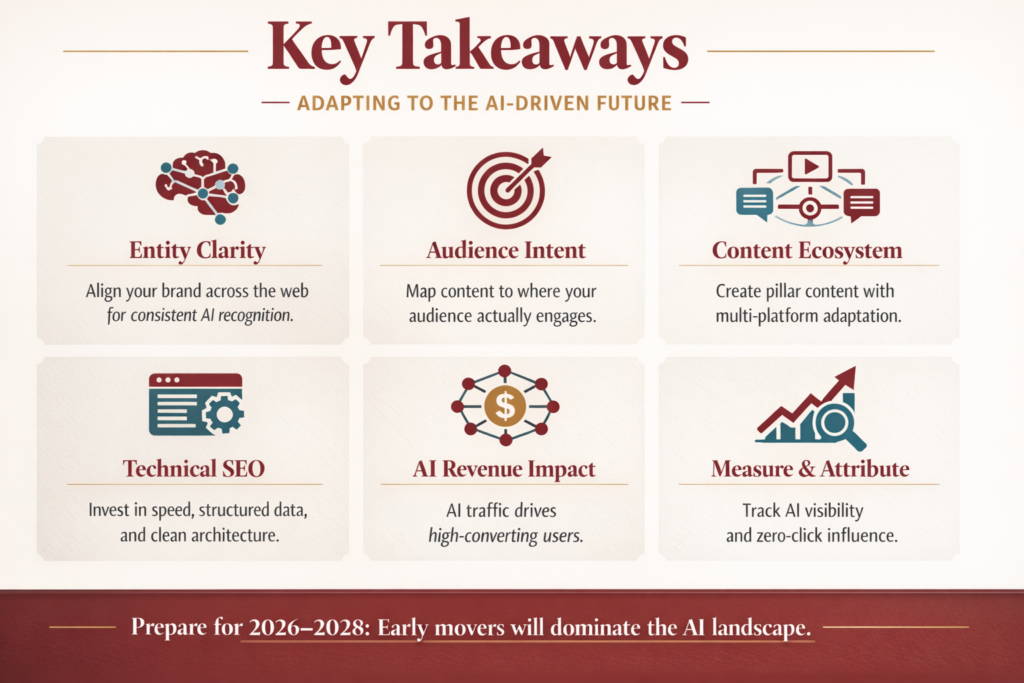
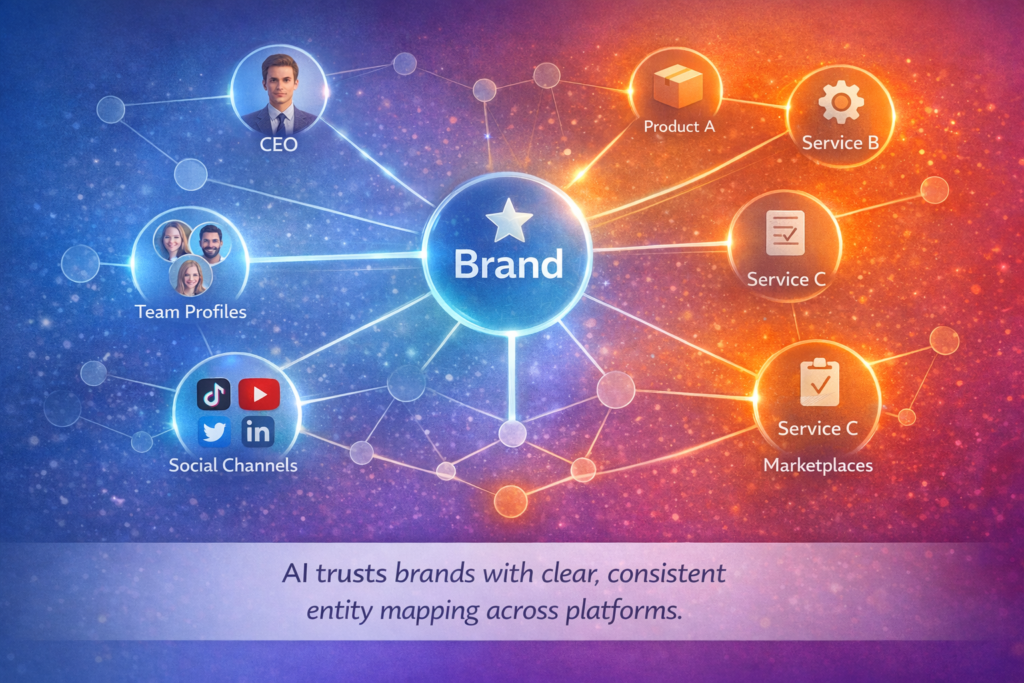
AI doesn’t think in keywords the way humans do. It thinks in entities—discrete, clearly defined things that it can recognize, categorize, and connect across the web. An entity can be your business, your services, your leadership team, your products, or even your unique expertise. Every platform, every profile, every piece of content acts as a signal to AI about who you are and what you represent. If those signals are inconsistent—different descriptions on LinkedIn, varied messaging across YouTube, conflicting narratives on your website—AI struggles to map your brand accurately. The result? Your visibility suffers, your authority is diluted, and your business risks being invisible when potential clients are asking critical questions.
Google itself emphasizes this in its guidance on knowledge graphs: consistency is a foundational trust signal. When AI sees a coherent, unified presence, it can confidently cite your brand as the answer. This principle extends far beyond Google. AI-driven systems like ChatGPT, Gemini, and Perplexity rely on the same signals. Brands that get entity alignment right aren’t just more visible—they become trusted references, appearing as authoritative sources across search, social, and AI-powered platforms.
As part of my service, I ensure your digital presence is fully aligned. Our web design services create structured, clear, and consistent web pages, while our SEO strategies tie every profile, service page, and content piece together into a unified entity network. From meta descriptions to service descriptions, from profile bios to landing pages, I make sure AI sees one brand, one story, and one trusted source. By building this clarity into your web architecture and messaging, you’re not just optimizing for search engines—you’re future-proofing your brand for the AI-driven decision-making ecosystem. Think of it like constructing a digital headquarters where every room, every sign, and every doorway consistently tells the same story: this is who you are, this is what you offer, and this is why clients can trust you.
Mini-Pattern 2: Entity Mapping Across Channels
When I analyzed cross-platform presence for hundreds of clients, those with consistent branding across LinkedIn, YouTube, Amazon, and niche platforms earned more frequent AI citations, faster indexing, and higher recommendation rates. Even subtle inconsistencies, like mismatched product names or CEO titles, disrupted AI trust, reducing visibility by measurable margins.
Your core identity should be unmistakable wherever it appears. This isn’t just about bios. It’s about narrative alignment.
Think of it like handing out business cards. If five cards list five different titles and phone numbers, trust erodes instantly.
Step Three: Building a Content Ecosystem, Not Isolated Posts
Most content strategies fail because they treat each piece as disposable. One blog post, one video, or one guide is created in isolation, published, and then forgotten. The problem with this approach is that it leaves content stranded—search engines may index it, but AI systems and users rarely see it in context, and the full authority of your brand is never established. The smarter, more future-proof approach is to build a content ecosystem, where each asset reinforces the others, creating a network of value that grows over time.
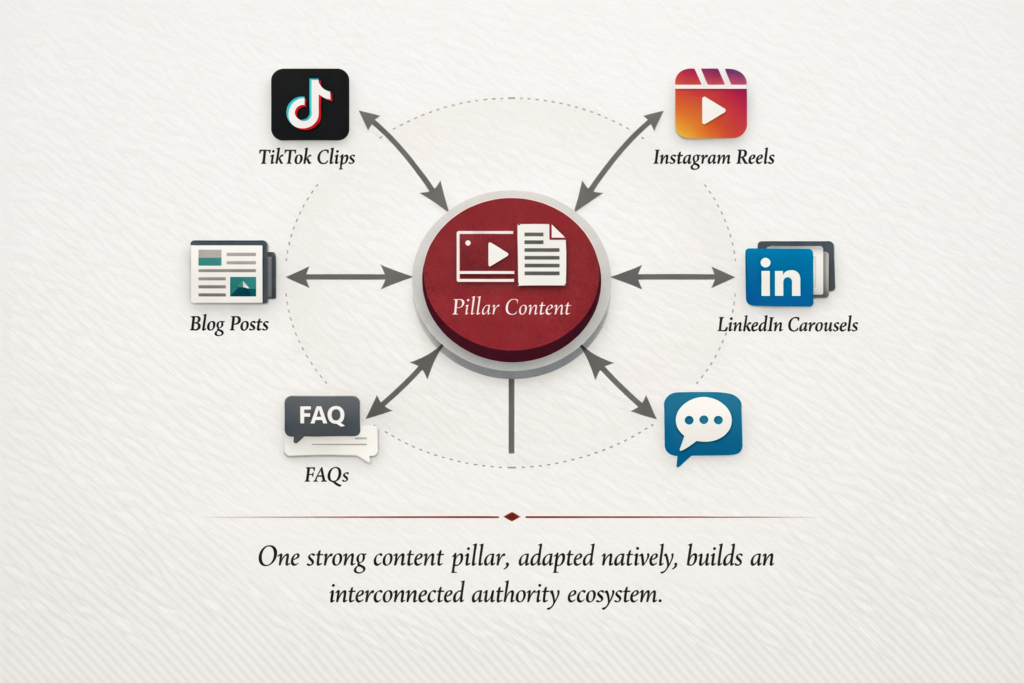
It starts with a pillar asset: a long-form video, a comprehensive guide, or an in-depth article that fully explores a topic from every angle. This becomes the anchor for your content strategy, the foundational resource that signals expertise to both humans and AI systems. From that anchor, every additional piece of content should be platform-native and purpose-driven. Short-form videos capture attention on TikTok or Instagram Reels. Structured articles with clear headings, bullets, and summaries make your content easier for AI to extract, summarize, and cite. Thought leadership posts on LinkedIn demonstrate authority, while FAQs and conversational content feed search engines and voice assistants. Together, these pieces create a web of visibility that ensures your brand is present wherever a decision is being made.
The data confirms this approach. Across AI platforms, there is a clear growing preference for citing video-backed sources. Over the last six quarters, AI citation of video content has climbed from 7% to over 12%, signaling that video isn’t just for engagement—it’s increasingly influential in shaping decisions and recommendations. I take this a step further by ensuring that your web design and SEO strategy are integrated into this ecosystem. Landing pages, blog structures, and video embeds are optimized so that AI can easily lift and reference your content. Every pillar page is designed with conversion-focused layouts, internal linking, and structured data to reinforce authority, while your supporting assets are strategically crafted to feed that pillar, amplifying both human and AI engagement.
By building a content ecosystem instead of isolated pieces, you’re not just creating more content—you’re creating a system that compounds over time, strengthening topical authority, boosting AI visibility, and turning your digital presence into a decision-making hub. In other words, your website isn’t just a collection of pages; it’s a living, interconnected network that positions your brand as the obvious choice across every platform, from search engines to AI assistants to social media. This is how forward-thinking businesses achieve sustained growth, and how Liam Consulting ensures your web design, SEO, and content strategy work together seamlessly to dominate the AI era.
Mini-Pattern 3: Cross-Platform Reinforcement
I have observed that when content from a single pillar is repurposed for multiple channels, the likelihood of being referenced in AI answers doubles or triples. For instance, a YouTube video converted into a TikTok snippet, a structured blog, and an FAQ page creates a multi-signal web that reinforces authority and trust.
Content that reinforces itself across platforms signals authority—not just to humans, but to machines.
Step Four: The Technical Layer That Powers Visibility
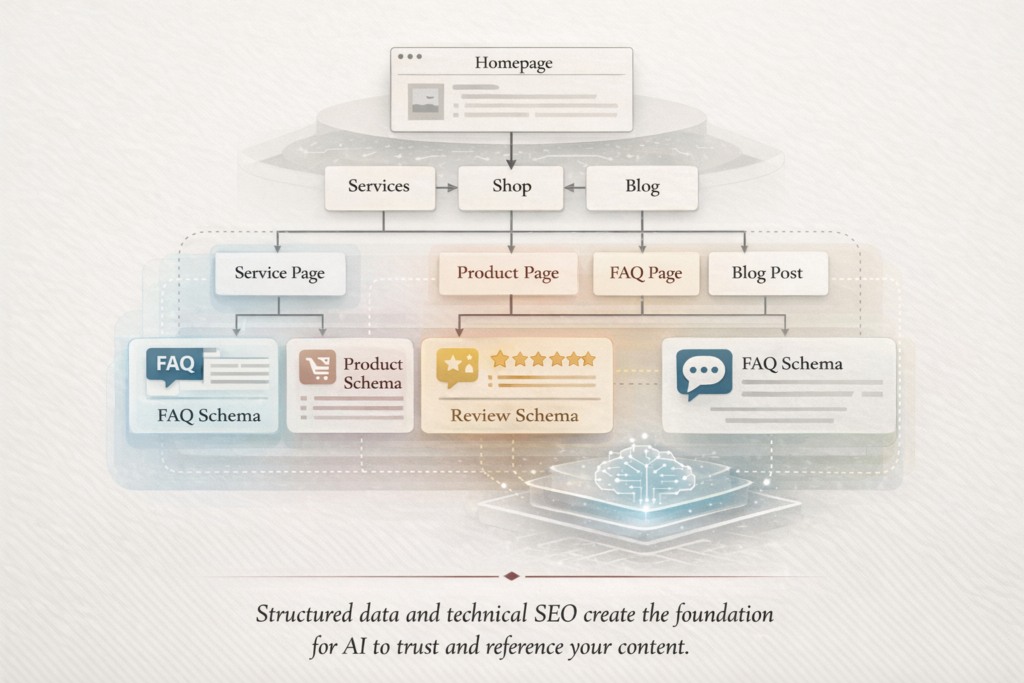
At this point, strategy meets reality. You can understand AI systems, intent mapping, and content ecosystems perfectly, but without a site that can technically support them, none of it compounds. This is where technical SEO and site architecture become critical. Clean structure, fast load times, and machine-readable context form the foundation that AI systems can trust and reference.
Great content without strong systems is like a sports car with no engine: it may look impressive, but it won’t take you anywhere. You can have the most insightful videos, guides, or blog posts in your industry, but if the underlying infrastructure isn’t optimized, AI systems and users alike won’t engage with your content the way they should. That’s why site speed, clean architecture, structured data, and schema markup are no longer optional—they are the foundation that powers visibility, trust, and conversions. Amazon famously demonstrated that even a one-second delay on product pages materially reduces conversions, proving that performance directly impacts the bottom line.
Structured data plays a critical role beyond traditional SEO. It helps AI systems understand relationships and context, not just isolated blocks of text. This is why brands like NerdWallet consistently appear in AI-generated answers: they’ve invested heavily in schema, entity mapping, and a consistent content ecosystem that signals authority across platforms. AI isn’t simply crawling pages; it’s building a mental model of your brand and offerings, and the clearer that model, the more likely it is to recommend your business in decision-making moments.
Equally important are engagement signals. Reviews, comments, social interactions, and responses act as trust accelerants. Platforms reward participation, not silence. Google Maps prioritizes businesses that respond to reviews. Amazon favors sellers who actively engage with questions. TikTok, Instagram, and LinkedIn algorithms push content that generates conversation. Every micro-interaction compounds into broader authority, sending both human and AI users a signal that your brand is credible, responsive, and trustworthy.
At Liam Consulting, I integrate these technical and engagement strategies into web design and SEO from the ground up. Every site I build is fast, mobile-optimized, and structured for AI extraction. Pages are architected with internal linking and schema markup that clearly communicates entities, services, and offerings. Reviews, testimonials, and engagement mechanisms are woven into the design so that trust signals are visible both to users and AI systems. By combining high-performing design, technical SEO, and content clarity, your brand doesn’t just exist online—it becomes a decision-ready destination, where AI recommends, users convert, and competitors struggle to catch up.
Think of it as turning your website into a high-performance engine for your content ecosystem: every page, every section, every piece of structured data works together to fuel visibility, authority, and client growth. Great content is the body of the car, but strong systems are the engine—and I make sure your engine runs flawlessly.
Step Five: AI Measurement, Attribution, and Feedback Loops
The winners in the AI era aren’t static. They adapt.
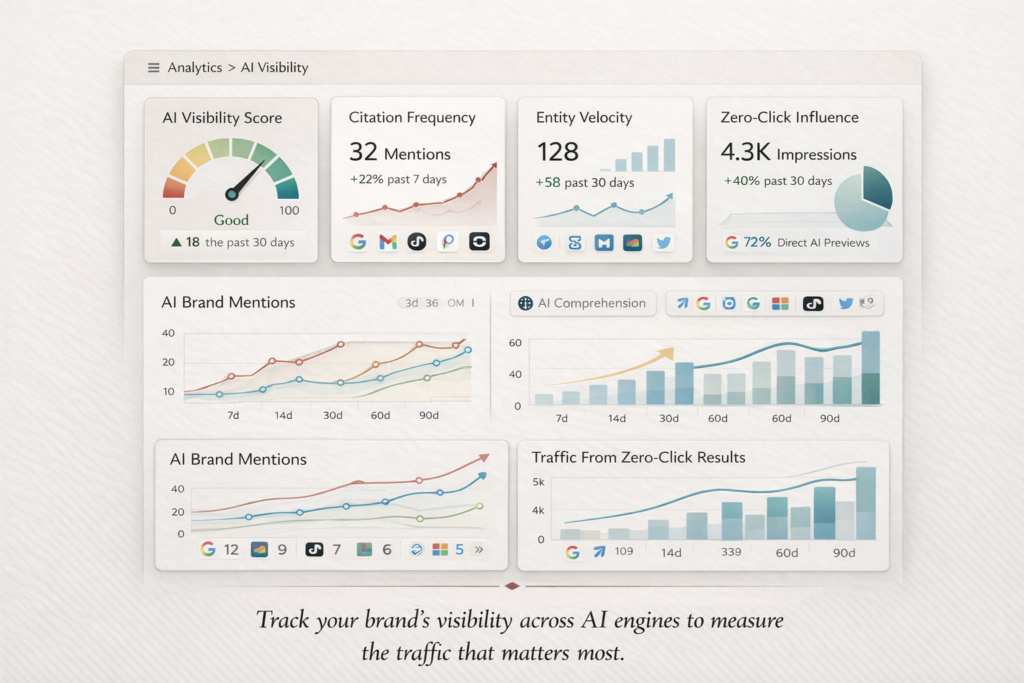
Tracking traditional metrics alone no longer tells the full story. Visibility inside AI answers, citation frequency, sentiment, and cross-platform presence are becoming the new performance indicators.
Expanded AI Measurement Section
- AI Visibility Score: How often your brand is included in generated responses
- Citation Frequency: Number of times your content is referenced as an authoritative answer
- Entity Velocity: Speed at which your brand gains topical authority across channels
- Zero-Click Influence: Impact on decision-making even if the user never clicks through
Research shows AI-sourced visitors convert up to 23x better than traditional search traffic. Engagement rates on AI-driven discovery often exceed 70%, significantly higher than conventional search channels. Even small improvements in structure, clarity, and cross-platform consistency compound rapidly over time.
Every improvement stacks on the last. Brands that regularly test, adjust, and refine visibility see compounding advantages that traditional SEO cannot replicate.
Why This Doesn’t Compete With Your Homepage
This page is strategic, not local. While your homepage anchors your core services, highlights your location, and signals primary commercial intent, this page goes broader: it builds topical authority around client growth, AI-driven visibility, and the next generation of digital discovery. Think of it as the high-rise tower complementing your flagship storefront—it doesn’t compete with your street-level presence, it elevates it, showing both clients and search engines that your brand is forward-thinking and trusted across the wider digital landscape.
By creating content that positions your business at the intersection of AI search, multi-platform visibility, and high-intent client acquisition, you extend your SEO footprint without cannibalizing your homepage. Every article, video, or web page element you build here can link back to your core offerings—your web design expertise, your SEO consultancy, and your conversion-focused digital solutions—creating a networked ecosystem of authority. Google, AI systems, and your future clients all see a consistent, strategic message: Liam Consulting doesn’t just provide services; I anticipate the shifts in how clients search, discover, and decide, and I design your digital presence to capitalize on them.
In short, this page doesn’t replace your homepage—it amplifies it. It ensures that when algorithms and decision engines evaluate your brand, they see a comprehensive, connected authority, ready to guide clients from curiosity to conversion across every platform, from Google Maps and LinkedIn to AI-driven assistants. Your web design and SEO services are the foundation, but this page is the scaffolding that ensures your brand grows taller, stronger, and more visible in the AI-driven landscape of tomorrow.
Looking Ahead: 2026–2028 Outlook
The next few years are set to accelerate digital change faster than ever. AI agents, multi-modal assistants, and zero-click search normalization are reshaping how people discover, evaluate, and choose products or services. In this future, traditional traffic metrics will only tell part of the story—brands will increasingly be judged by whether AI trusts and cites them in real-time decision-making, even when users never click a single link. Those who establish visibility and credibility now are not just chasing immediate conversions; they are embedding their brand into the memory of potential clients, creating lasting authority that competitors will struggle to replicate.
Think of it like acquiring a prime plot of digital real estate before the city has been built. The later you wait, the more crowded, expensive, and competitive the landscape becomes. Each AI platform—from ChatGPT to Gemini to Perplexity—acts like a different neighborhood, with its own audience behaviors, rules, and opportunities. Brands that understand these nuances and craft content ecosystems across platforms will be “visible everywhere” while others remain invisible, stuck relying on outdated SEO playbooks.
By 2028, AI-driven decision engines will likely dominate B2B and B2C research journeys, replacing traditional keyword-driven search as the primary pathway to customers. Companies that invest in entity clarity, structured AI-friendly content, and platform-specific design strategies today will enjoy a compounding advantage. At Liam Consulting, I help businesses do exactly that—our web design and SEO services ensure that every page, every profile, and every piece of content is optimized not just for human users but for AI systems. This way, your brand doesn’t just appear in search results—it becomes part of the answers clients trust, long before your competitors even realize the shift is happening.
Ready to Grow Your Business in the AI Era?
Whether you need a modern website that converts, expert SEO strategy, or guidance to dominate AI-driven search, I can help. Let’s build a clear path to visibility, traffic, and client growth—tailored specifically for your business.
Book a Free ConsultationFinal Thought: Growth Belongs to the Brands That Adapt First
The AI era didn’t arrive with a warning. It arrived quietly, reshaping how decisions are made.
Client growth now belongs to brands that understand one truth: visibility isn’t about being everywhere. It’s about being chosen.
And in a world where AI increasingly decides what gets seen, clarity, trust, and structure matter more than ever.
This is the moment to build for the next version of search—before it becomes crowded, expensive, and out of reach.